Wednesday, May 02, 2007

Spirit #5, Action #6, and the True Story of Kareem Abdul-Jabbar

Lew Alicindor was a famous basketball player who was the best player in the NCAA when he played for UCLA in the late 1960s. In 1971, after playing a few years in the NBA, Mr. Alcindor legally changed his name to Kareem Abdul-Jabbar (he had used the name informally for several years before then.) Alcindor/ Adbul-Jabbar had a long and successful professional basketball career, primarily with the Los Angeles Lakers.

Fast-forward to 1993. Abdul-Jabbar's career is over. General Motors uses the name "Lew Alcindor" is an advertisement an Oldsmobile that airs during the NBA finals. Kareem Abdul-Jabbar sues, saying that GM does not have the right to use his name in a commercial without his consent. GM responds that they didn't use his name. They used a name that Mr. Abdul-Jabbar intentionally abandoned back in 1971. It was not "his name" any more, and therefore he did not have any rights to it.

The answer -- to me at least -- is not obvious. Of course a person has a right to protect his name. And of course a person has a right to change his name. On the one hand, Lew Alcindor and Kareem Abdul-Jabbar are the "same person," and a statement like "Lew Alcindor loves General Motors" would lead a normal person to believe that Kareem Abdul-Jabbar had similar sentiments. On the other hand, there was a deliberate renunciation of the name. If something is abandoned, then its free for anyone else walking along the roadside to pick up and keep.

This case was in the back of my mind as I read The Spirit, along with Action Comics #6, in which Superman makes a similar discovery that his identity had co-opted by a con-man. In Action #6, the con-men quickly move from financial fraud to attempted murder, which makes the case a little easier than the Lew Alcindor case. In Spirit #5, the con-man make the dubious claim that the Spirit can't do anything to him because the Spirit has no legal rights to his own name.

In any event, a few things that floated through my mind as I read yet another excellent issue of The Spirit.

Labels: , , ,

Tuesday, January 02, 2007

Playing 52 Pick-Up with Racism (The Spirit #1: Cover Dated February 2007)


Characters

Main Heroes: The Spirit, Ginger Coffee
Minor Hero: Ebony, Mr. Wang

Major Villains: The Pill

P'Shat

National Network News Anchor Ginger Coffee has just been kidnapped live and on-air by masked gunmen believed to be working for "The Pill" -- crime lord Amos Weinstock -- upon whom Coffee had planned an expose linking him to various crimes. The gunmen are holding Coffee in an abandoned building where they are met by The Pill and Mr. Wang. After the crime lord departs, The Spirit makes his first appearance, breaking throug the upholstery of his car.

The Pill asks Coffee about her informant, but already knows it is Mr. Wang, whom the Pill kills/dissolves/melts/whatever with his blobby hands. As Coffee tries to run, the Spirit makes his move, and effects a rescue of Coffee, climbing first onto the roof, and later into the sewer system.

Coffee calls the TV station and leaves her phone on so that they can hear her daring escape. The broadcast makes rivetting television, but it lets everyone -- cops and robbers -- know where they are. Witty banter ensues until The Spirit discovers the cell phone. Caught between The Pill and a rogue cop, The Spirit and Coffee are saved at the last minute by Ebony, who swerves between them in his cab for the rescue.

Drash

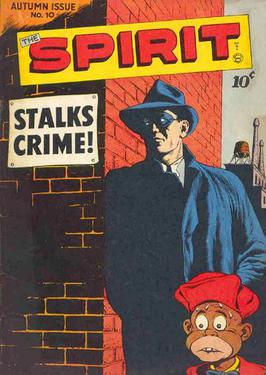
There are certain issues which face any re-launch of a racially insensitive work. In the Spirit, the issue was what to do about that person in the lower right hand corner below.


That's Ebony, and on one hand he was a trailblazer -- the first major black sidekick in an inter-racial crime fighting comic book team. On the other hand -- well, the other hand is pretty obvious. Just look at him. Among the unresolved issues was whether he was a "man" or a "boy". At a time when grown black men could be called "boy", it didn't really make a difference. He was short and boyish, but he could also drive the getaway car.

So, let's posit (without concluding) that Ebony was a racial step forward for 1940, and a racial embarrassment for 2007. What do you do with him now for The Spirit, V.2?

Well, the first thing you do is you get 20 pages into the story mixing the racial pot so much that you don't remember which stereotype is which. Consider:

Ginger Coffee: Obvious racially-charged "colorful" name for a light-skinned black woman with almond-shaped eyes, given a powerful job, and not any hugely glaring black stereotypes or female stereotypes -- but a huge "reporter stereotype". She'll "do anything to get the story", including leaving her cell-phone on, talking in reporter-speak to broadcast her own rescue, putting herself and everyone around her at risk. It's a trite stock-character, but not an offensive one.

The Pill: Amos Weinstock. Plays on Bugsy Siegel/ Meyer Lansky Jewish-gangster stereotype that was big back when the original Spirit was published, but has lost its relevance now. There is even "stock footage" of Weinstock showed on a news broadcast of him in Cuba. Havana was a popular hang-out for gangsters (both Jewish and otherwise) in the 1950s. The Godfather has a scene set in Cuba feature Moe Greene, based in part on Bugsy Siegel, but was set before the Communist revolution. The "Cuba" footage is likely an homage to either the Godfather or that upon which the Godfather is based, but it is certainly an anachronism if The Spirit is supposed to be set in the modern day (as a black news anchor would imply). Gangsters stopped going to Cuba when Castro took over.

But The Pill himself is physically verging on pustulent albino -- skin nearly indistinguishable from his chalk-white suit. It is a disgusting display of Caucasian-ness gone awry.

Mr. Wang: Asian gangster, employee of The Pill turned informant. Good guy? Bad guy? He doesn't last long enough to find out.

The Spirit: Sure, he's a white guy , and a good guy, back when that was the unbroken norm. But here we get an explicit play on being "raceless"-- as a white man is perceived to be in America:

Coffee: So what's with all the drama? I mean, the hat and mask don't hide much . . . Is it how you get your freak on?

The Spirit: *Sigh* (covering Coffee's eyes) Describe me.

Coffee: Rigggght. I get it. You're a big blue average with a distraction stuck to his face.


See? He's not "a white guy". He's the incredible raceless wonder. The invisible man. Oliver Queen's mask doesn't disguise anything, because of the distinguishing facial hair, etc. The Spirit, though, is "generic man" -- brown hair, blue suit. It's confirming the "raceless" stereotype by drawing attention to it, and the fact that it works, without succumbing to it.

So, this is all in prelude to:

Ebony.

He is drawn to look about 20 years old, and maybe five feet tall. No facial hair. Young, but not childish. Ginger Coffee addresses him first upon being rescued in his cab:

Coffee: Now who is this snack-sized Nubian savior?

Ebony: Name's Ebony.

Coffee: Ebony? You're playin' me right? I mean, when you get home, do you stand on this guy's lawn with a lantern, or what?

Spirit: No, it's Tuesday. I stand on his lawn tonight. Geez, Eb, I'm sorry --

Ebony: I ain't shook. Besides . . This one's friendlier than your usual dates.


So, we have a black character pointing out, "Yes your sidekick appears to be an extreme racial stereotype". The one white character in the car jumps to his defense, and together they insult her in gender-specific terms.

So, we are left with a question. Is the book racist and sexist? Or is it a non-racist, non-sexist book ABOUT racism and sexism? I can see it both ways, and it will be interesting to see where it goes from there. Ebony and a dozen caucasians in every issue, or will playing with stereotypes become a feature instead of a bug? Given the baggage that The Spirit -- and the character of Ebony in particular -- comes with, this is probably the best outcome imaginable for Issue #1.

Labels: , ,